
How Mimer AI Factory is helping researchers at Umeå University bring real-time, AI-driven treatment closer to reality
| Organization | Umeå University — Department of Diagnostics and Intervention |
| Key players | Prof. Tufve Nyholm & Dr. Anders Garpebring |
| Support from | Minh Vu, Mimer AI Factory |
| System used | Alvis at C3SE, Chalmers University of Technology |
| Field | Medical physics / Radiation oncology |
| Focus area | Deep learning for real-time radiotherapy treatment optimization |
| Stage | Proof of concept — preparing for scientific publication |
The challenge of time in radiotherapy
Radiotherapy is one of the most common treatments in cancer care — around half of all patients will undergo it at some point. Yet one of the field’s most persistent challenges is deceptively simple: time.
Today, treatment planning is a careful but slow process. A patient is imaged, then sent home while clinicians optimise the treatment plan — a process that can take several hours over the course of days. By the time the patient returns and treatment begins, the body has already shifted. Organs move. Tumours change position. The plan drawn up from yesterday’s scan may not perfectly match today’s anatomy.
Professor Tufve Nyholm, who leads the radiation physics group at Umeå University, is exploring how AI might help close this gap.


How deep learning might help
The core idea is to replace the current iterative, semi-manual optimisation process with a deep learning model that can generate a viable, individualised treatment plan in a few minutes, fast enough to implement before the patient heads home.
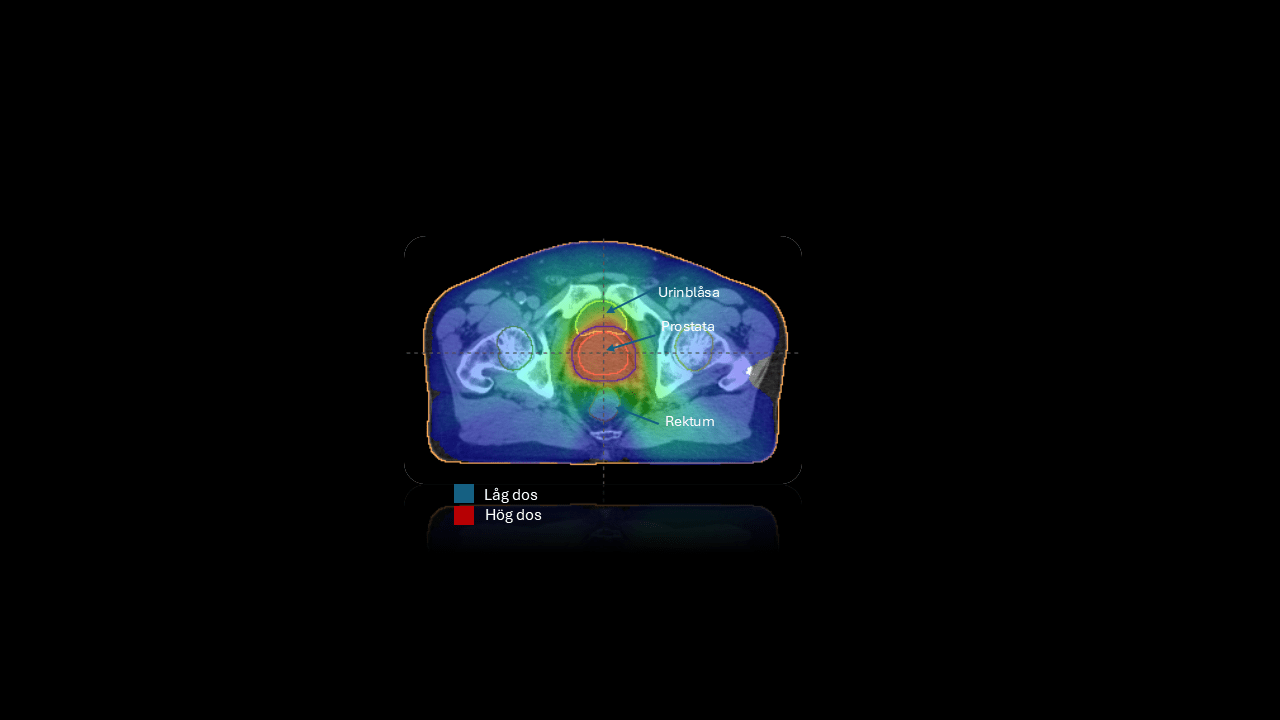
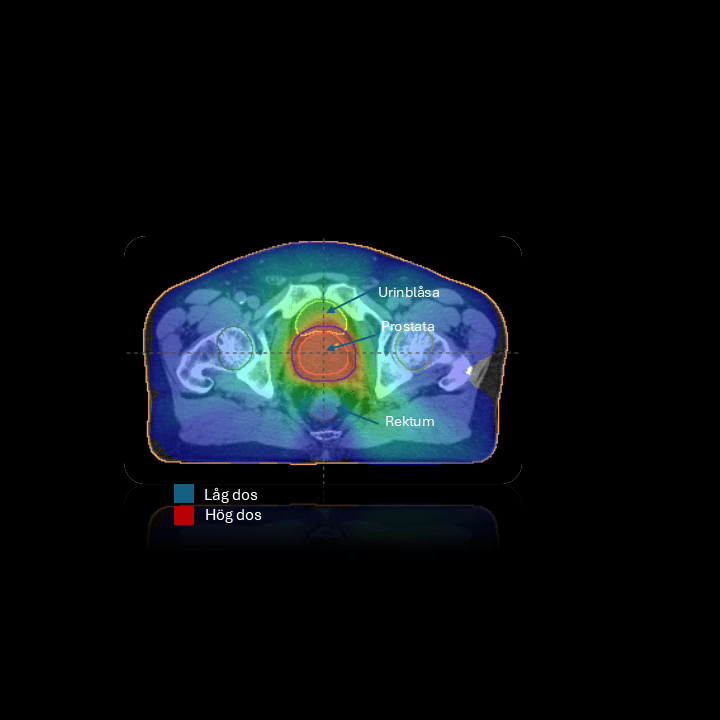
The model takes in medical images and data about how a patient’s disease is distributed, then produces a treatment plan tailored to that person at that moment. The potential impact is significant: reduced margins, lower toxicity, and the possibility of escalating treatment intensity without increasing side effects.
The team’s initial proof-of-concept focuses on prostate cancer – a deliberate choice, given the abundance of available patient data – in collaboration with a research group in Vienna. The principle, however, could be generalisable across cancer types.
Mimer AI’s role
The collaboration with Mimer AI Factory centered on the deep technical work of building a robust, end-to-end AI pipeline. Minh Vu of Mimer AI brought specialized expertise in the architecture of deep learning networks to the project.
As Nyholm described it, the contribution was less about running known methods and more about knowing how to shape the network itself.

The core challenge was building a pipeline that connects everything – from patient geometry and dose constraints, through a deep leaning model, to an actual dose calculation engine – in a way that is both numerically stable and physically meaningful. Getting those pieces to talk to each other correctly was the real engineering problem.
Minh Vu, Mimer AI Factory
Specific support included integrating an updated dose calculation engine into the AI framework, adapting the deep learning model for compatibility, establishing a clean end-to-end data flow between geometry, dose computation and optimisation, and systematic testing for numerical stability and performance.
Preparing a proof-of-concept, and beyond
The team is now focused on completing the proof-of-principle results for prostate cancer to demonstrate clearly that AI-based optimization of this type of problem works, as well as preparing a scientific publication.
If successful, the longer-term vision is compelling: a system that could compress the time between imaging and treatment delivery to almost nothing, enabling a form of radiotherapy that accounts for internal motion in real time.
If we can do a really quick optimisation — take the images, do an optimisation that will be almost instant, and then treat right away — all lot of uncertainty will disappear. That is the real goal.
– Prof. Tufve Nyholm
From prostate cancer, the aim is to expand to other indications, and ultimately to a generalised system that could reshape how radiotherapy is delivered across cancer care.