
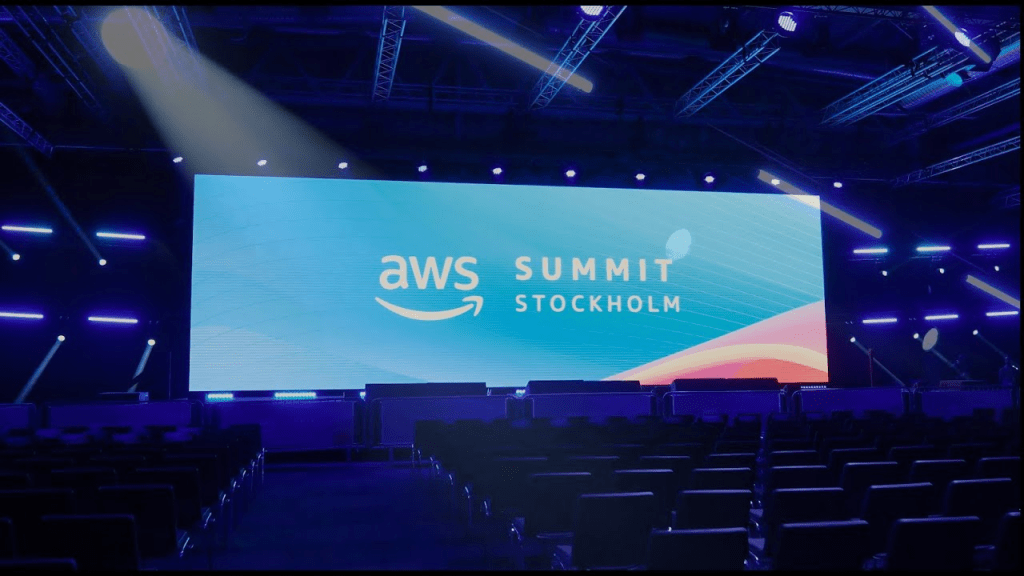
Photo from AWS Summit Stockholm 2026 (https://aws.amazon.com/events/summits/stockholm/).
By Luca Panconi.
Building with AI
A recurring message throughout the day was that the AI conversation is changing. For the past few years, much of the focus has been on building models, experimenting with generative AI tools, and identifying early use cases. At the AWS Summit, the discussion moved toward something more operational: how organisations can build with AI, embed it into real workflows, and use it to accelerate innovation across science and industry.
This theme was captured particularly well in a session from Anthropic on the evolution of agentic AI, who framed it like this: “We have seen software as a product, then software as a service, and now we are moving toward software as a colleague”. In this sense, agents are not simply chatbots or passive assistants, but systems that can plan, act, use tools, reflect on outcomes, and repeat this process across complex workflows.
Increasingly, AI is becoming a collaborative layer that can help automate analysis, retrieve relevant data, and support decision-making. As was said during the session, some of the fastest-growing startups are not necessarily building AI, but building with AI.
AI Across Industry
The keynote speech placed the Nordic region firmly within the global AI landscape, and speakers highlighted that the Nordics are among the leading regions in Europe for enterprise AI adoption.
Several industry examples illustrated this point. Pharmaceutical companies like Novo Nordisk have shown how AI and cloud infrastructure can accelerate biomedical research and improve the lives of patients. Zenseact, the Swedish autonomous driving company, demonstrated their use of cloud-enabled AI in supporting complex engineering systems where safety, simulation and real-world performance come together. DNB Bank also presented work on a multi-agent architecture for Know Your Customer workflows, using cloud infrastructure and Amazon Bedrock to support financial crime prevention.
The keynote also emphasised the economic potential of AI in Europe. Cloud-enabled AI was said to have the potential to add hundreds of billions of euros to Europe’s GDP, yet only 3% of European organisations have currently deployed agentic AI. This gap between potential and deployment is exactly where support structures become essential. Many organisations know that AI could transform their work, but they still need help with infrastructure, data, governance, model development and secure deployment.
Hands-on Learning
The summit placed a real emphasis on practical learning. There were a number of hands-on technical sessions and interactive learning opportunities, with content ranging from best practices and service features to in-depth technical coverage for participants with more advanced familiarity.
It was clear that many organisations don’t just need access to hardware or software. They need help translating their problem into an AI workflow, choosing the right tools, preparing their data, optimising their models, and understanding how to scale responsibly.
The event really brought together strategic vision and practical implementation, offering a view of where the technology is going, while also giving participants a chance to engage with the tools, architectures, and expertise needed to build real systems.
Mimer and the Next Phase of AI Adoption
Agentic AI is lowering the barrier to advanced technical work. It can help developers write and modernise software, support researchers in analysing complex data, assist companies with operational workflows, and enable new forms of collaboration between humans and machines. But this potential depends on access to compute, secure data infrastructure, and expert guidance.
As Sweden’s AI Factory, Mimer supports researchers, start-ups, small-to-medium enterprises, and public sector organisations with free access to GPU supercomputing infrastructure, expert technical support and training.
The AWS Summit was a strong reminder that AI innovation is not only about models. It is about the ecosystems that allow people to use those models effectively. From life sciences and autonomous systems, to finance and quantum research, the organisations that succeed will be those that combine domain knowledge with the right technical infrastructure.
Many research groups and SMEs have strong domain expertise, but limited time or resources to design scalable AI infrastructure from scratch. Mimer is here to help bridge this gap, and move Sweden’s academic and industrial communities from experimentation to real-world impact.