
By Gabriella Kalteneckar, Senior Project Manager
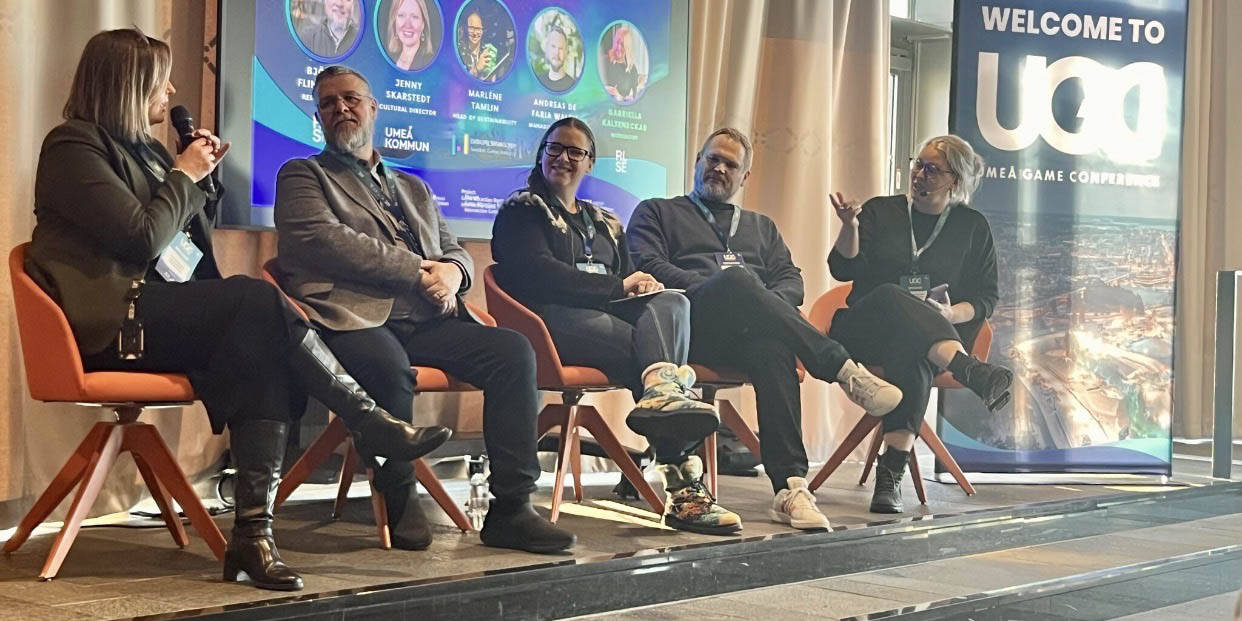
Last week, the Mimer gaming team had the pleasure of participating in the Umeå Game Conference (UGC) 2026. The event gathers developers, publishers, investors, researchers, public actors and international guests for conversations focused on the future of games, technology and creative industries. Mimer, being active within the Swedish gaming industry, was there.
The opening panel, which I moderated, reflected on a turbulent but transformative period for the Swedish games sector. Despite continued global success stories and strong export figures, the industry has faced structural challenges during the past year. Among these are reduced access to capital, market consolidation, global layoffs, and – in a Swedish context – changes to the national education landscape following decisions by the Swedish National Agency for Higher Vocational Education (MYH), which have disproportionately affected game education programmes in northern Sweden.
At the same time, speakers emphasised that gaming remains one of Sweden’s most important cultural and technology-driven industries: highly global, innovation-intensive, and deeply interconnected with AI, simulation, real-time systems and user-centered design.
AI, infrastructure and new forms of support
A recurring theme throughout the conference was the growing role of AI as infrastructure rather than abstraction. Mimer is one of just two European AI Factories (of a total of 19) which are explicitly focusing on gaming and game technology. For us, games are not only products but advanced testbeds for real-time interaction, simulation, autonomous systems, analytics and responsible AI deployment.
My Mimer colleagues Björn Flintberg and Ingrid af Sandeberg hosted a well-attended session where discussions centered on how small and medium-sized studios can practically access AI and HPC capacity, and also on how shared base modules, toolkits and reusable components can lower the threshold for adoption while still allowing companies to differentiate through their own data, pipelines and creative processes. There was substantial interest from studios, publishers and investors alike, and we booked several follow-up meetings with potential future clients of Mimer’s offerings.
Mickaël Zehren, a technical specialist from Umeå University who is also with Mimer, contributed hands-on technical expertise in discussions with studios and other stakeholders, particularly around AI architectures, data strategies and practical implementation considerations. He enabled deeper, more solution-oriented conversations, bridging advanced research, infrastructure capabilities and real-world industry needs.
The importance of place, community and collaboration
From a regional perspective, the conference highlighted why local engagement matters. Umeå’s long-standing investment in culture, creativity and digital competence creates fertile ground for collaboration between public actors, academia and industry. The municipality’s commitment to games both as a cultural form and an economic driver was clearly articulated, as was the importance of creating environments where talent can grow, stay and return.
As the industry moves into 2026 there is cautious optimism. While the market remains demanding, new tools, infrastructures and collaborative models are emerging that can strengthen resilience, particularly for smaller studios and experimental teams that form the backbone of the ecosystem.
We are grateful to the UGC organisers, Umeå Municipality, the speakers, and the engaged community of participants for the warm welcome, thoughtful discussions and genuine curiosity. The level of engagement around the Mimer AI Factory and future collaborations confirms the importance of meeting the Swedish gaming industry where it is and building forward together.
Get access to AI development support and infrastructure!
Mimer offers both expert support for your AI projects and GPU infrastructure. Browse to see what we offer or contact us!